


Basic English
Navigation: Home
→ Beginning Level
→ Basic English
→ to be
Pages in this lesson: Letters - Numbers - Pronouns - to be - Questions Words
This page: Learn the affirmative, negative and interrogative form of the verb "to be".
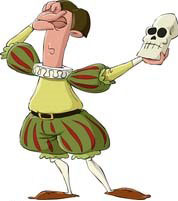
To be, or not to be
The verb "to be" is the most common verb in English, so it's very important to understand how to conjugate it well. It's an irregular verb and has different forms depending on the subject (different conjugations). The verb "to be" also has contracted forms (abbreviated forms).
| Affirmative and Negative (Contractions are in parentheses.) Negative in red text |
Interrogative |
|---|---|
| I am (I'm) I am not (I'm not) |
Am I _____? |
| He is (He's) He is not (He isn't, He's not) She is (She's) She is not (She isn't, She's not) It is (It's) It is not (It isn't, It's not) |
Is he _____? Is she _____? Is it _____? |
| You are (You're) You are not (You aren't, You're not) We are (We're) We are not (We aren't, We're not) They are (They're) They are not (They aren't, They're not) |
Are you ____? Are we _____? Are they _____? |
Watch a video to learn the forms of the verb "to be." Follow our "The English Minute" YouTube Channel and learn English in just a few minutes with our short video lessons.
The verb to be in the affirmative has the form am in the first person singular (I), the form is in the third person singular (he, she, it), and are in the second person singular, second person plural, and third person plural (you, they, we). Click on a link to hear the pronunciation.
| ► I am |
| ► He is |
| ► She is |
| ► It is |
| ► You are |
| ► We are |
| ► They are |
Section 1
Select the correct form of the verb "to be."
A contraction is a shortened way of saying something. In English, contractions are very common. When forming contractions, we remove one or more letters and replace them with an apostrophe (').
| ► I am | ► I'm |
|
► He is ► She is ► It is |
► He's ► She's ► It's |
|
► You are ► We are ► They are |
► You're ► We're ► They're |
Section 2
Use the table above to write the following sentences with contractions. Click the "Check" button to check your answer. Make sure you write the uppercase or lowercase letters correctly, as appropriate, and add a period or question mark at the end before checking. Also, if you write two spaces between words instead of one, the computer will interpret this as an error when checking.
Examples
He is a teacher. → He's a teacher.
I am a student. → I'm a student.
There are several ways to form the negative of the verb to be in English. It can be formed with or without a contraction. Generally, we only use the uncontracted negative when we want to emphasize it. For example, if I say "I am not a student," I am emphasizing that I am not a student because you thought I was. In the following exercise, we will practice the most common way of forming the negative (see table below).
| Affirmative | Negative |
|---|---|
| ► I am | ► I'm not |
| ► is | ► isn't |
| ► are | ► aren't |
Section 3
Use the table shown above to write the following sentences in the negative.
Examples
I am a teacher. → I'm not a teacher.
He is a student. → He isn't a student.
To form a question in English with the verb to be, you must put the verb (am, is, or are) first, followed by the subject of the sentence.
He is a student. → Is he a student?
You are from Mexico. → Are you from Mexico?
Section 4
Change the sentences into questions.
Example
She is a teacher. → Is she a teacher?
Section 5
Answer the questions as if you were that person. Look at Tomás Pérez's example below and then answer Sandy Watson's questions.
| Name | Tomás Perez |
|---|---|
| Country | Mexico |
| Occupation | student |
Examples
What is your name?
Where are you from?
What is your occupation?
| Name | Sandy Watson |
|---|---|
| Country | England |
| Occupation | teacher |
Now answer the questions as if you were Sandy.
Write five sentences with the verb to be describing yourself and your friends.
Examples
I am a student.
I'm not a teacher.
Fernando is a dentist.
Write in the comments section below. Passport to English is a community of people who want to learn English for free. Please be supportive of each other. If you see a mistake in someone's writing, please respond with the correction. Remember that comments other than those written by Janet Castrejon (the author of this website) do not represent Passport to English. If someone posts inappropriate comments on this page, please send a message to mail@passporttoenglish.com and include the page where you saw the comment.
Beginning Level -
Basic English
Letters - Numbers - Pronouns - to be - Questions Words
Do you prefer to learn English with short video lessons? Follow us on our "The English Minute" YouTube Channel.
Beginning - Intermediate - Advanced - Teachers
Pronouns - Pronunciation Rules - Verbs - Irregular Verbs
Vocabulary - Grammar - Pronunciation - Spelling