


Lesson 9 - Sports/Hobbies
Navigation: Home
→ Beginning Level
→ Lesson 9
→ Grammar
Pages in this lesson: Vocabulary - Grammar - Listening - Dialogue - Reading - Pronunciation - Dictation - Game
This page: Review of the present continuous and
the present participle, the verb "Like," words ending in -er

He is driving a car.
First, let's review the present continuous. As we mentioned earlier, this tense is used to describe actions that are happening right now. To form the present continuous, we combine a form of the verb to be (am, is, are) with a present participle (the form of the verb that ends in -ing).
| Examples of the Present Continuous |
|---|
| I am walking. |
| He is walking. |
| She is walking. |
| They are walking. |
| You are walking. |
| We are walking. |
Remember that to form the present participle, you add -ing.
play → playing
If the word ends with the letter e, we change it to -ing.
drive → driving
If the word ends with a consonant, followed by a vowel, then another consonant, and the stress of the word is on the last syllable, we repeat the last consonant before writing -ing (except for the letter "w").
run → running
swim → swimming
Describe what they are doing using the given verb. Make sure you have correctly capitalized the letters and included the period at the end.
example
He/ride a horse
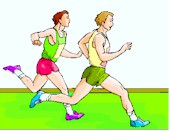


The verb like can be used with two forms of the verb: the form of the verb ending in -ing or the infinitive (the word "to" followed by the verb). Both forms are correct and have very similar meanings. For example:
I like to swim.
I like swimming.
Note: While we previously learned that the -ing form is called the "present participle," when it's used as a noun, as it is with the verb "like," it is called a "gerund." The present participle and the gerund are formed in the same way, however. Both end with -ing.
Describe whether you like or don't like doing these activities. You can write the answer with the infinitive ("to" and the verb) or with the gerund (-ing form).
example
run
Possible answers
I like to run. -or- I like running. -or- I don't like to run. -or- I don't like running.
In English, nouns can be formed by adding the ending -er to verbs, to refer to a person who performs that activity.
Practice
What person does these activities?
example
teach
Instructions example |
Write a paragraph describing what you think your family and friends are doing right now.
example Kim is cleaning the house. Mike is working on his computer. etc.
Write in the comments section below. Passport to English is a community of people who want to learn English for free. Please be supportive of each other. If you see a mistake in someone's writing, please respond with the correction. Remember that comments other than those written by Janet Castrejon (the author of this website) do not represent Passport to English. If someone posts inappropriate comments on this page, please send a message to mail@passporttoenglish.com and include the page where you saw the comment.
Beginning English -
Lesson 9 - Sports/Hobbies
Vocabulary - Grammar - Listening - Dialogue - Reading - Pronunciation - Dictation - Game
Do you prefer to learn English with short video lessons? Follow us on our "The English Minute" YouTube Channel.
Beginning - Intermediate - Advanced - Teachers
Pronouns - Pronunciation Rules - Verbs - Irregular Verbs
Vocabulary - Grammar - Pronunciation - Spelling